
"How Did We Get Here?"
Money is at its core.

“How did we get here?”
We hear that question a lot these days.
Like most things, there is no easy answer, although some want us to think there is. We probably all know at least one person who is so sure that if we just do “X, then we’ll solve Y'“.
Relationships, situations, laws, policy—life—though, aren’t mathematical formulas. Most fall within a frustrating gray zone. That’s what makes things like governing and diplomacy—and living in a constitutionally limited democratic republic—so hard.
But that doesn’t answer the question, “How did we get here?”
How did we get the most corrupt administration in American history, or at least the last century?
How did a politically inexperienced former slumlord the Nixon administration charged with racial housing discrimination in the 1970s and went on to get fired from his own reality television show for racism, launched a political career on a racist lie about the first African American president not being born in America, kicked off his presidential bid with racist slurs against Mexicans, parrots Russian propaganda, was impeached twice—once for inciting an attempted coup to keep himself in power—was convicted of 34 counts of election fraud, was found civilly libel for sexual assault, and called the playboy child rapist Jeffrey Epstein his “best friend” (his words), get elected president of the United States twice?
We could spend all day counting the ways he is unfit to hold the nation’s highest office as there is no pat answer to which we can point a finger. While the multiple factors would keep us endlessly arguing, there is one at the core of the issue, however.
Money.
Let’s step into the way-back machine to the halcyon days of 1976.
Jimmy Carter was elected president that year, and he was perceived as the moral antidote to president Richard Nixon’s corruption.
But with every progressive advancement, there is always a right-wing backlash, and that came that year in a big way in the form of a Supreme Court (SCOTUS) decision.
January 30, 1976, the nation’s highest court handed down the massively consequential Buckley versus Valeo decision that equated money with free speech, stating that since political campaigns require monetary expenditures to promote candidates’ messages, any attempt to curtail campaign spending should be considered an infringement of the first amendment right to free speech.
According to the Brennan Center for Justice:
The Buckley Court did two things: It upheld contribution restrictions, reasoning that limits help control corruption. And it struck campaign spending restrictions, reasoning that spending money does not involve a transaction between a donor and a candidate, and thus there is no possibility of corruption.
Two years later the court struck again in First Nat’l Bank of Boston v. Bellotti. This decision doubled down on Buckley in that it conceded the “corporate personhood” argument. Mitt Romney famously pronounced in a speech at the Iowa State Fair in 2011 when he was running for president against Barack Obama the essence of the Bellotti decision when he said, "Corporations are people, my friend".
This opened the flood gates to wealthy corporations essentially buying political influence, something that was outlawed in the Tillman Act in 1907.
Thirty years after this feeding frenzy was legitimized, SCOTUS took another bite at the apple in 2010 with Citizens United v. FEC, the decision President Obama decried in that year’s State of the Union address when he said, with SCOTUS judges sitting right in front of him:
I don't think American elections should be bankrolled by America's most powerful interests, or worse, by foreign entities. They should be decided by the American people. And I'd urge Democrats and Republicans to pass a bill that helps to correct some of these problems.
It was a three-pronged assault. The Buckley decision blew up campaign spending restrictions; the Bellotti decision asserted faceless, soulless corporations have the same constitutional rights to free speech as living, breathing humans; and Citizens United extended it by giving any special interest, domestic and foreign, carte blanche to pump as much money as it sees necessary into political spending through super political action committees, or “super PACs” to circumvent candidates’ donation limits.
The result has been exactly what you think it would be.
Grift, grift, and more grift.
When people pay for something, they expect something for it.
So when Ohio republican gubernatorial candidate Vivek Ramaswamy pays for a $10 million TV and digital ad campaign to run from now to Election Day, he’s expecting that the more than twice his Democratic opponent Amy Acton is spending is going to pay off, policies be damned. Since announcing his candidacy last month, Ramaswamy’s net worth jumped from $1 billion to about $1.8 billion.
On March 9, New York Times reporters Mike Baker and Steven Rich (ironic name) published a story explaining how underwriting political campaigns for every office from school board to president of the United States has enabled the morbidly rich to solidify tax cuts, deregulation, and cuts to the social safety nets in addition to making sure they’re reaping the financial benefits of government contracts.
As Heather Cox Richardson reported in Thursday’s installment of Letters From an American:
300 billionaires and their immediate family members donated 19% of all political contributions in federal elections, either directly or through political action committees (PACs). While that amount does not account for money that might have gone through dark money groups that don’t have to disclose their donors, it still amounts to more than $3 billion, or an average of $10 million per family.
She goes on to point out that Montana senator Tim Sheehy beat popular incumbent Jon Tester two years ago with “the help of $8 million from billionaire Stephen Schwarzman and at least 63 other billionaires and 37 of their immediate family members, who donated about $47 million to Sheehy’s Senate race.”
Elon Musk poured $300 million into 2024 elections. By the end of last year, he had given $20 million to republicans to gird them for the upcoming midterms.
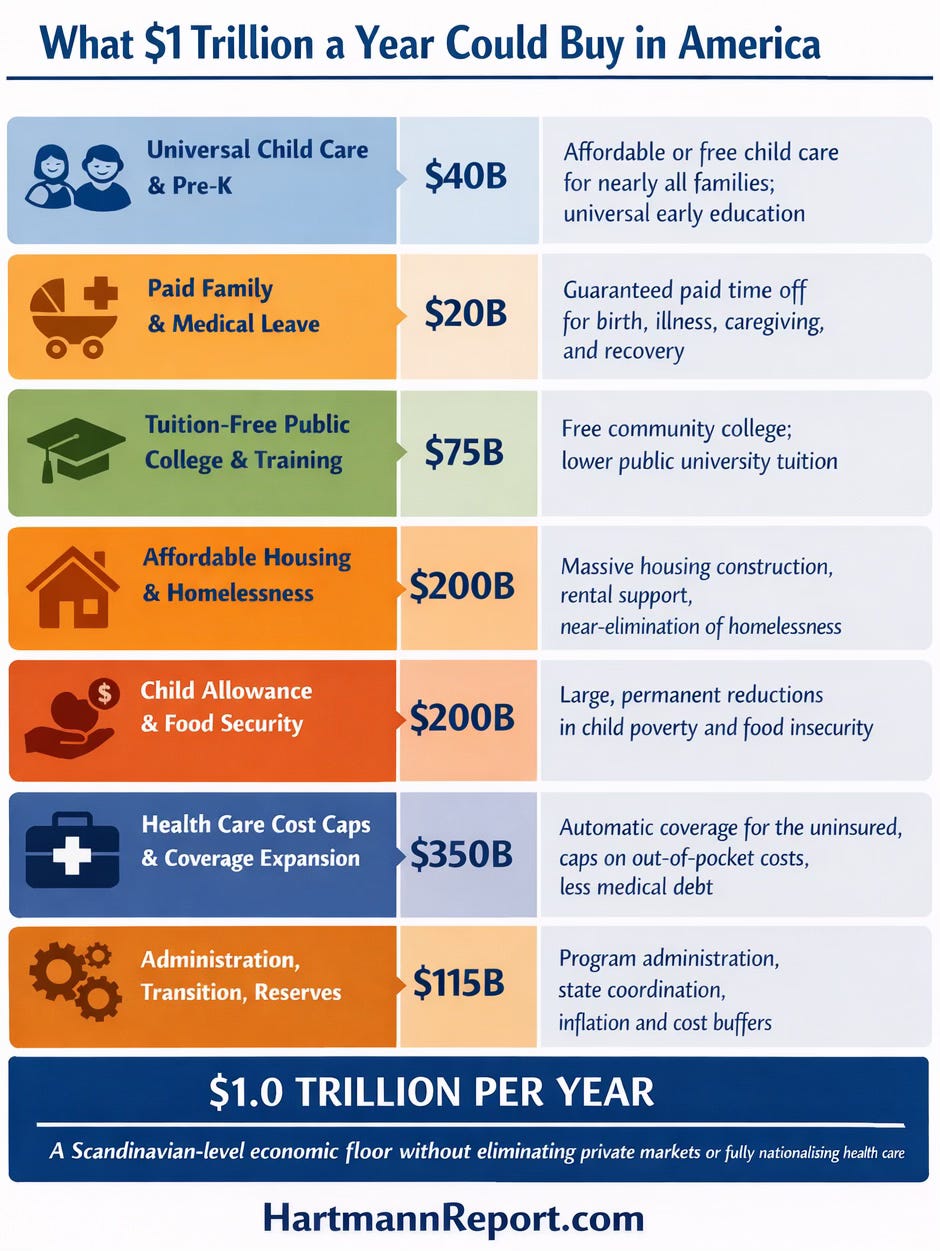
In July, without a single Democratic vote, the republican congressional majority passed the “Big Beautiful Bill”, the $4.5 trillion package that takes money from 90% of Americans like you and me who need it and hands it to the richest one percent who don’t. In it, the trillion dollars that could have funded everything in the above graphic was cut from healthcare alone, stripping 11 million people of their health insurance, causing 16 million Americans to lose coverage.
This is in addition to the $1.5 trillion in permanent tax breaks to corporations and the wealthy in the “Tax Cuts and Jobs Act passed during the felon’s first term.
Add to that the tax cuts George W. Bush passed (and don’t forget to throw in the two illegal wars he waged off the books).
Add to those the tax cuts George H.W. Bush and Ronald Reagan passed, and we’re left with $51 trillion that have been successfully and incrementally transferred from the middle class into the pockets of the morbidly rich, who are “investing” much of it right into the super PACs of republican lawmakers who promise to cut their taxes even more. With enough money lost in couch cushions, they have invested in over 1,500 right-wing radio stations, about 700 religious stations, and a not-insignificant number of right-wing Spanish language stations that routinely parrot republican talking points and endorse candidates for office.
Include the cable TV networks cos-playing as news, like Fox, One America News Network, and Newsmax.
While we’re at it, throw in a mind-boggling number of right-wing websites, and we’ve got a propaganda infrastructure convincing millions of average Americans like you and me that it’s “patriotic” to squeak by year after year, watching their children and grandchildren’s financial futures shrink, rather than do anything that might resemble dreaded “Socialism”.
Former labor secretary Robert Reich stated last week:
In recent days, we’ve begun to see indications that videos criticizing Trump’s war in Iran are being suppressed on the U.S. version of TikTok, which was sold to a group led by Trump loyalist Larry Ellison earlier this year.
Nearly half of 18- to 29-year-olds rely on TikTok as a primary source of news, so this is a big, big deal.
But that’s not all. Ellison and his son also now own CBS News, and their coverage of the Iran war has been so slanted that CBS insiders are calling it “propaganda-palooza.” Worse yet, the Ellisons are on the verge of taking over CNN. In fact, just yesterday, Pete Hegseth said, “The sooner David Ellison takes over that network, the better.”
Never in my lifetime have I seen this degree of authoritarian capture of the media.
Garbage in, garbage out.
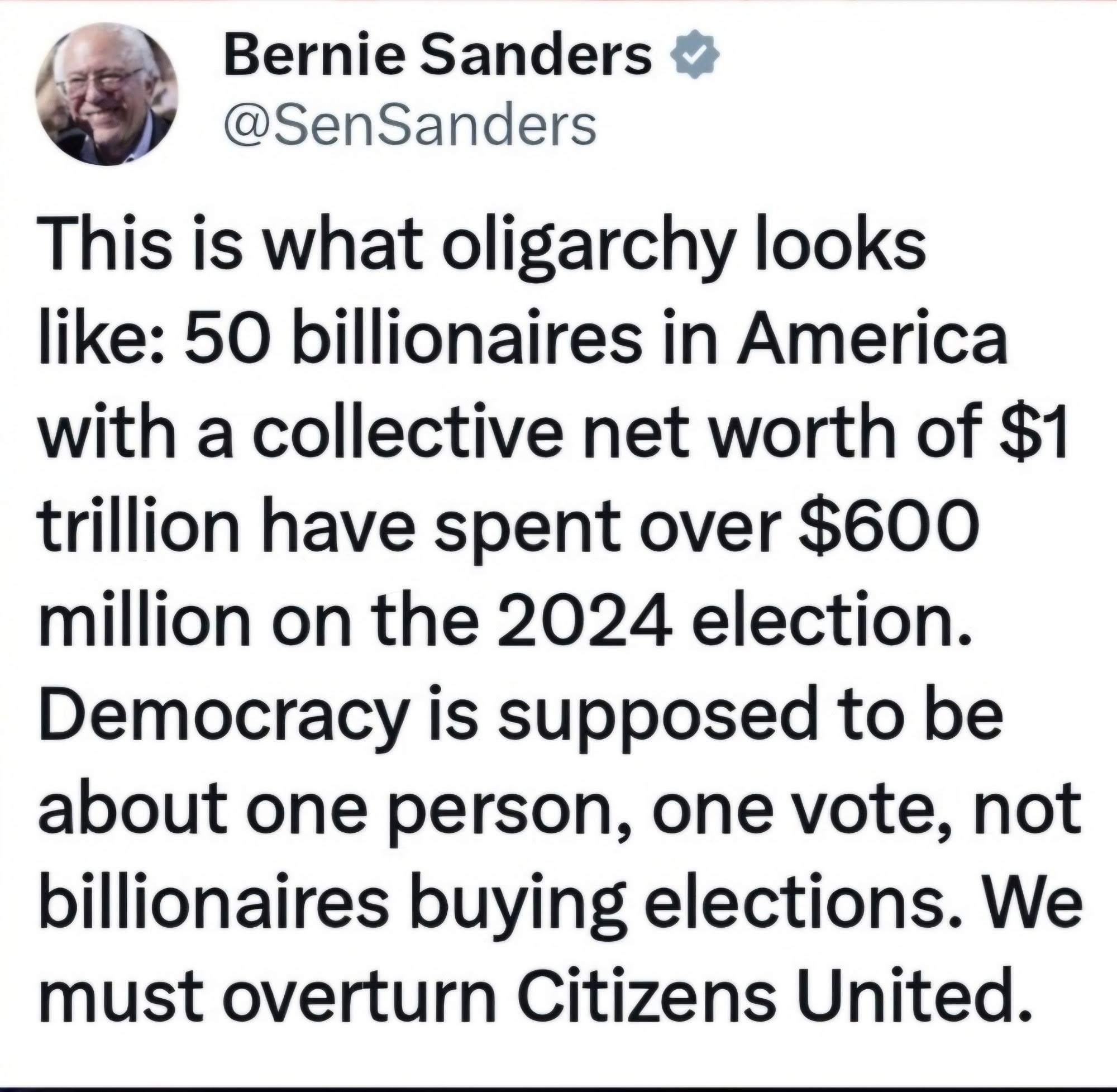
We got here because of money—the cancer at the core of our political system.
The Grifter-in-Chief currently pretending to be a “leader” is merely the hood ornament on a car that has been picking up speed for over 50 years. Getting rid of him through impeachment or natural causes isn’t going to change the system that put him there. That requires a systemic revision—and that’s not easy.
Joe Biden is the only president in 45 years to explicitly repudiate so-called “trickle-down economics”.
If the Democratic party is serious about bringing back the country we were from the 1930s to the 1980s, it must embrace a 21st-Century New Deal that includes repealing the disastrous Citizens United Supreme Court decision; repealing the Reagan tax cuts, both Bush tax cuts, and both Trump tax cuts; raising the minimum wage to keep pace with inflation; and return the marginal tax rate to top earners to around 90 percent.