
Taking Back Democracy Will Take More Than Just Getting Rid of the Orange Menace
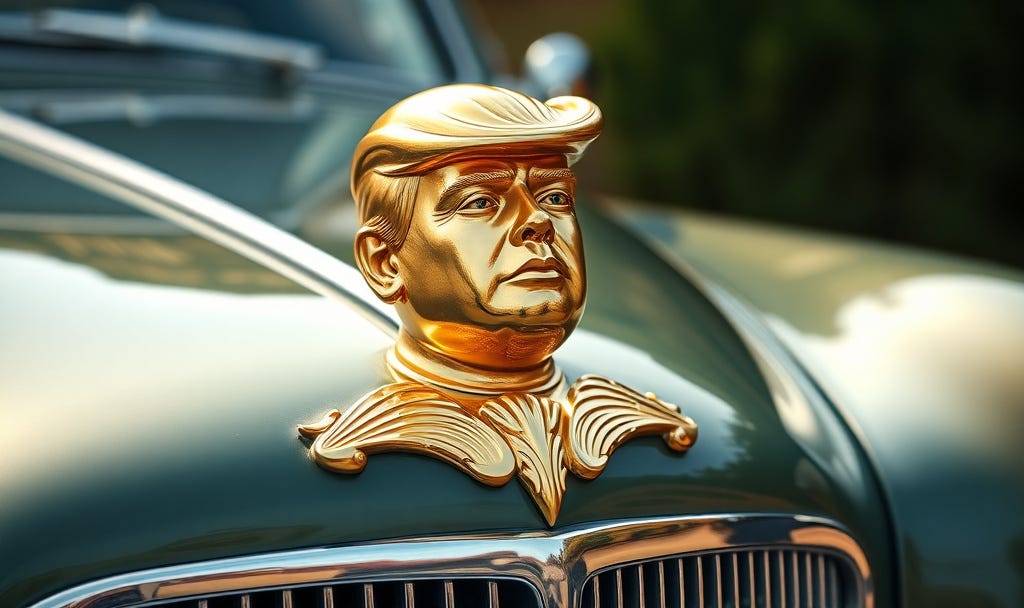
He is the hood ornament on the car that’s been chugging along before he sat in the Oval Office and will continue long after he’s been replaced. But that doesn't mean change is impossible.

Americans—and maybe not just Americans—are obsessed with quick fixes.
As convenient and more efficient our technology has allowed us to be, we have become used to immediacy.
Is there anything these days for which there isn’t an app?
Need coffee? Dunkin and Starbucks will have it ready for you after you place an order from your car or comfortable living room couch. Or, just pop a K-cup into the ol’ Keurig or any of its cheaper knockoffs.
Need groceries? Curbside pickup became popular during the pandemic.
Need to perform a repair on your house or car? Hop onto YouTube; it’s unlikely someone didn’t create content about the same issue. Or, with AI programs like ChatGPT, Perplexity, Claude, and Gemini, it’s like having a manual walking you through whatever it is you need to do.
We could go on listing ways technological advancements that have made our lives easier and more efficient. With every upside, there’s a downside, though. One unfortunate outcome of all this convenience is expectation: We start to expect problems to be addressed with an app click, AI search, or video. Research attesting to the damage such immediacy and multitasking does to our concentration and patience is well documented.
What about politics, though?
Sadly, that too is impacted.
While technology like websites, social media, electronic canvassing lists, digital voter registration forms, online petitions, and so on are a boon to grassroots activism, we’ve become more consumed with the quick remedy to our myriad issues.
How many times have we heard someone—political pundit or neophyte—say, “If we just do X, we’ll solve Y”?
How many times have you heard, “If we just get that orange menace out of the White House…”?
I’ve heard it a lot lately, and people look at me askance (and probably assume I’m secretly MAGA) when I tell them that won’t fix all that ails us. Get rid of the felon with the 25th Amendment, impeachment, or natural causes, and we get vice president JD Vance. Not an improvement. In the presidential line of succession, after the vice president comes the House Speaker, Mike Johnson. Also not a promising prospect.
The good news is, the convicted felon’s time as pretender to the presidency is limited. Either by impeachment, 25th Amendment, 22nd Amendment, or death in office, he is not going to be in his current role in perpetuity.
But the system that inappropriately elevated him to the nation’s highest office—twice—still stands with or without him. He is the hood ornament on the car that’s been chugging along before he sat in the Oval Office and will continue long after he’s been replaced. His republican successor could be worse.
The only thing left to do, then, is fix the system, and that’s not something an app or click will rectify. It will take getting inside the political process—getting active, having a seat at the table deciding who runs for political office, and relentlessly pushing our elected officials to stay on the right side of democracy with the policies they promote and the bills they support.
Everything broken can be fixed. This includes elements of the political and electoral system that put us into our current situation.
In a Yale Review essay published in September, Rana Dasgupta states:
With or without Trump, the American republic is mutating away from what it was during the high-constitutional era of the late twentieth century. The real story, then, is that mutation—and the crisis from which it stems.
There are, of course, myriad factors. But at the root is money.
In 1971, an obscure corporate lawyer named Lewis Powell penned a memo to the U.S. Chamber of Commerce that would come to up-end the political zeitgeist for half a decade.
That memo stated the business community was losing America; universities, media, and the courts were eschewing so-called “free enterprise”. Powell warned if corporations didn’t use the influence they potentially held, capitalism would be doomed. (Oh, no!)
Powell’s memo encouraged businesses to get off the non-partisan bench and infiltrate the media and education.
And they did.
Richard Nixon put Powell on the Supreme Court, and within 10 years, think tanks were founded for “alternative” academic research that always seemed to naturally favor republicans and fiscal policies that advocated cutting taxes on the very businesses behind the research.
The proliferation of right-wing talk radio started to indoctrinate millions of listeners with talking points and an agenda that would make them good soldiers in the battle to destroy the very programs helping them.
President Ronald Reagan put in charge of the Education Department Bill Bennett, an anti-public education zealot, who proceeded to starve school districts of resources and remove civics education so students wouldn’t learn how their government works (or doesn’t).
Morbidly rich ideologues like Charles and David Koch single-handedly “invested” hundreds of millions of dollars to sow skepticism in science and government.
January 30, 1976, the nation’s highest court handed down the massively consequential Buckley versus Valeo decision that equated money with free speech, stating that since political campaigns require monetary expenditures to promote candidates’ messages, any attempt to curtail campaign spending should be considered an infringement of the first amendment right to free speech.
According to the Brennan Center for Justice:
The Buckley Court did two things: It upheld contribution restrictions, reasoning that limits help control corruption. And it struck campaign spending restrictions, reasoning that spending money does not involve a transaction between a donor and a candidate, and thus there is no possibility of corruption.
Two years later the court struck again in First Nat’l Bank of Boston v. Bellotti. This decision doubled down on Buckley in that it conceded the “corporate personhood” argument. Mitt Romney famously pronounced in a speech at the Iowa State Fair in 2011 when he was running for president against Barack Obama the essence of the Bellotti decision when he said, “Corporations are people, my friend“.
This opened the flood gates to wealthy corporations essentially buying political influence, something that was outlawed in the Tillman Act in 1907.
Thirty years after this feeding frenzy was legitimized, SCOTUS took another bite at the apple in 2010 with Citizens United v. FEC, the decision President Obama decried in that year’s State of the Union address when he said, with SCOTUS judges sitting right in front of him:
I don’t think American elections should be bankrolled by America’s most powerful interests, or worse, by foreign entities. They should be decided by the American people. And I’d urge Democrats and Republicans to pass a bill that helps to correct some of these problems.
It was a three-pronged assault. The Buckley decision blew up campaign spending restrictions; the Bellotti decision asserted faceless, soulless corporations have the same constitutional rights to free speech as living, breathing humans; and Citizens United extended it by giving any special interest, domestic and foreign, carte blanche to pump as much money as it sees necessary into political spending through super political action committees, or “super PACs” to circumvent candidates’ donation limits.
The result has been exactly what we think it would be.
Grift, grift, and more grift.
When people pay for something, they expect something for it.
So when Ohio republican gubernatorial candidate Vivek Ramaswamy pays for a $10 million TV and digital ad campaign to run from now to Election Day, he’s expecting that the more than twice his Democratic opponent Amy Acton is spending is going to pay off, policies be damned. Since announcing his candidacy last month, Ramaswamy’s net worth jumped from $1 billion to about $1.8 billion.
On March 9, New York Times reporters Mike Baker and Steven Rich (ironic name) published a story explaining how underwriting political campaigns for every office from school board to president of the United States has enabled the morbidly rich to solidify tax cuts, deregulation, and cuts to the social safety nets in addition to making sure they’re reaping the financial benefits of government contracts.
As Heather Cox Richardson reported in an installment of Letters From an American:
300 billionaires and their immediate family members donated 19% of all political contributions in federal elections, either directly or through political action committees (PACs). While that amount does not account for money that might have gone through dark money groups that don’t have to disclose their donors, it still amounts to more than $3 billion, or an average of $10 million per family.
She goes on to point out that Montana senator Tim Sheehy beat popular incumbent Jon Tester two years ago with “the help of $8 million from billionaire Stephen Schwarzman and at least 63 other billionaires and 37 of their immediate family members, who donated about $47 million to Sheehy’s Senate race.”
Elon Musk poured $300 million into 2024 elections. By the end of last year, he had given $20 million to republicans to gird them for the upcoming midterms.
When the president—as a candidate for a second term, after two impeachments, a 34-count election fraud indictment, and civil liability for sexual assault—promises fossil fuel executives that for a million-dollar donation to his campaign that he’ll cut their taxes, they are exploiting systemic rot that has existed for decades—and will continue if we just go on expecting the glitches to self correct, or, even more dangerously, that this has always been the way it is and there’s nothing we can do about it.
No wonder, without a single Democratic vote, the republican congressional majority passed the “Big Beautiful Bill”, the $4.5 trillion package that takes money from 90% of Americans like you and me who need it and hands it to the richest one percent who don’t. In it, the trillion dollars that could have funded everything in the above graphic was cut from healthcare alone, stripping 11 million people of their health insurance, causing 16 million Americans to lose coverage.
This is in addition to the $1.5 trillion in permanent tax breaks to corporations and the wealthy in the “Tax Cuts and Jobs Act passed during the felon’s first term.
Add to that the tax cuts George W. Bush passed (and don’t forget to throw in the two illegal wars he waged off the books).
Add to those the tax cuts George H.W. Bush and Ronald Reagan passed, and we’re left with $51 trillion that have been successfully and incrementally transferred from the middle class into the pockets of the morbidly rich, who are “investing” much of it right into the super PACs of republican lawmakers who promise to cut their taxes even more. With enough money lost in couch cushions, they have invested in over 1,500 right-wing radio stations, about 700 religious stations, and a not-insignificant number of right-wing Spanish language stations that routinely parrot republican talking points and endorse candidates for office.
Include the cable TV networks cos-playing as news, like Fox, One America News Network, and Newsmax.
While we’re at it, throw in a mind-boggling number of right-wing websites, and we’ve got a propaganda infrastructure convincing millions of average Americans like you and me that it’s “patriotic” to squeak by year after year, watching their children and grandchildren’s financial futures shrink, rather than do anything that might resemble dreaded “Socialism”.
Much of the institutional malaise and rot had already started weakening the political structure by 2016 when a certain politically inexperienced former slumlord the Nixon administration charged with racial housing discrimination in the 1970s and went on to get fired from his own reality television show for racism launched a political career on a racist lie about the first African American president not being born in America, and kicked off his presidential bid with racist slurs against Mexicans.
This does not mean his exit from the White House would be insignificant and pointless, however.
It’s imperative Democrats sweep upcoming midterms elections as they did this past November. It’s looking more positive every day they will win back the House; even the Senate is in play. That really seems the only way to prosecute any meaningful accountability against a republi-con party that has abdicated its authority over the executive branch. A third impeachment would be good start, then maybe start hauling before congressional hearings toadies obfuscating the Epstein files. Accountability is possible.
But even accountability is not a panacea.
We as a citizenry must remain engaged with our feet on the gas. Assuming the supreme court, Congress, Democrats, progressives, activist groups, No Kings rallies, are going to be the finger that flips the switch for utopia is a fallacy. We need—we must—be at the vanguard of change and elect progressives committed to returning us to the values of FDR’s New Deal that created the most prosperous 40-year period in our country’s history. That was done by overhauling the federal government from the ground up.
We did it then, and we can do it again.
It won’t be easy, or quick—but nothing worth doing is.